OVERVIEW
The primary objective of World Languages in the Greenburgh Central School District is to ensure that students gain a deep and lasting understanding of cultures while acquiring a high level of proficiency in the languages we offer. We aim to give students global perspectives that shape how they see themselves in both local and global communities, while fostering empathy and a deeper appreciation of world cultures.
As a K–12 International Baccalaureate School District, GCSD offers Mandarin Chinese (K–12) and Spanish (Grades 4–12). Grammar and vocabulary are taught explicitly and through contextualized learning experiences that make language acquisition meaningful and authentic. Culture plays an important role, as language and culture are inseparable. The ability to communicate in multiple languages bridges gaps and connects us to people around the world. Our World Languages teachers ensure that students are prepared to navigate cultural and linguistic differences, opening doors to social, academic, and career opportunities.
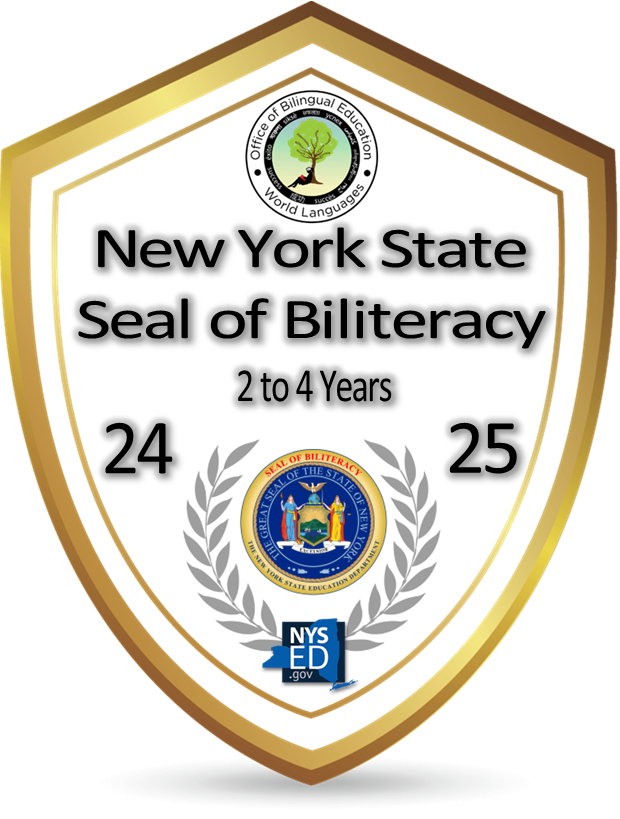
Greenburgh Central School District has been recognized by the New York State Education Department through the New York State Seal of Biliteracy (NYSSB) program. This designation reflects the district’s commitment to multilingualism and the academic achievement of students who demonstrate proficiency in two or more languages.
For the 2025–26 school year, GCSD has been recognized as a NYSSB School and NYSSB Seal Coordinator. In 2024–25, the district earned 2nd–4th Year Silver recognition, as well as distinction for students attaining proficiency in 2 world languages in addition to English. These recognitions highlight the strength of our World Languages and ENL programs and reinforce our focus on preparing students for success in a global society.
Together, these programs reflect GCSD’s commitment to developing effective communicators, critical thinkers, and compassionate global citizens, ready to succeed academically and personally in an ever-changing world.
CURRICULUM
The World Languages curriculum includes universal topics aligned with the New York State scope and sequence, as well as transdisciplinary themes connected to our IB Programme. These topics are revisited each year in a spiraling sequence, building upon prior knowledge and skills. Some topics are introduced only at advanced levels due to their abstract nature and linguistic demands.
As students progress through the program, they are expected to demonstrate greater confidence and control over grammatical structures, enabling them to communicate effectively in the target language.
Curriculum Topics Include:
|
|
- House & Home
-
Health & Welfare
-
Shopping
-
Cultural Diversity
-
Family Life
|
-
Education
- Travel
-
Customs & Traditions
-
Community & Neighborhood
-
Earning a Living
|
- Communication & Media
-
Technology
-
Physical Environment
-
Leisure
-
Global Issues
|
K–8 WORLD LANGUAGES: Checkpoint A
In the early years, the emphasis is on listening and speaking, with gradual introduction to reading and writing. Teachers use engaging, age-appropriate activities to help students develop novice-level fluency.
Students at Checkpoint A can:
- Comprehend simple, familiar vocabulary and structures in conversation with peers and adults
- Understand the main idea of conversations with some unfamiliar words and cognates
- Use repetition, rephrasing, and nonverbal cues to derive meaning
- Initiate and engage in simple conversations with more fluent or native speakers
Assessment:
Students complete Checkpoint A at the end of Grade 8 with a locally developed assessment. Successful completion provides 1 unit of high school credit, encouraging continued study.
9–12 WORLD LANGUAGES: Checkpoint B
High school students continue their study of Mandarin or Spanish to build fluency beyond memorized responses.
Students at Checkpoint B can:
- Comprehend messages and short conversations in face-to-face or phone interactions
- Understand the main idea and details in media such as TV, radio, or streaming video
- Initiate and sustain conversations with fluent or native speakers
- Use vocabulary across a range of topics, employ sentences in multiple time frames, and add details with appropriate modifiers
- Exhibit spontaneity in interactions, using repetition, circumlocution, and nonverbal cues as needed
Assessment:
Checkpoint B is completed at the end of Grade 10 with the Checkpoint B Exam (formerly the Regents Exam). Successful completion provides 3 Regents credits toward graduation.
ADVANCED STUDY: IB & Checkpoint C (Grades 11–12)
World language study is a core component of the International Baccalaureate Diploma Programme. Students may pursue IB language study for the full diploma or earn a Certificate of Participation. These advanced courses prepare students for college-level work and require them to analyze, discuss, and present on complex global topics in the target language.
IB Themes Include:
- Communication & Media
- Global Issues
- Social Relationships
- Optional: Cultural Diversity, Customs & Traditions, Health, Leisure, Science & Technology
Students at Checkpoint C can:
- Understand standard speech in authentic settings
- Comprehend main ideas and details of extended discussions, media, films, and songs
- Use a wide range of vocabulary, idioms, and structures
- Recognize nuanced meaning with limited repetition or rephrasing
- Engage in extended discussions with fluent or native speakers on broad, global topics
Assessment:
Students complete IB assessments in Grade 12. Other advanced courses culminate in locally designed assessments.
IN CONCLUSION
Cultural fluency — the ability to understand people and perspectives in both their context and our own — is an indispensable skill in today’s interconnected world. At GCSD, our World Languages program equips students to become engaged, responsible, and compassionate global citizens. Multilingualism and multicultural understanding are among the most valuable and adaptable assets we can provide our students as they prepare for college, careers, and a rapidly changing world.
RESOURCES